Gravestones
St Wulfram's is fortunate in having a large number of slate
gravestones, a number of which have survived over 200 years.
To see a list of monumental inscriptions in St Wulfram's
churchyard, please visit this external site www.interment.net and search: cemeteries
for England, Lincolnshire, St Wulfram, then go to the page for the
surname you are interested in.
Memorial
plaques, tombs and monuments
War
Memorial
The stories of some people commemorated in St Wulfram's
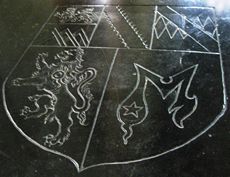 |
Francis Malham. The table-top tomb in the
North Aisle is for Francis Malham of Elslack, which is near Skipton
in Yorkshire.
He died in Grantham in 1660 on his way to
Yorkshire and was buried in St Wulfram's by his third wife
Jane.
He was a distinguished Royalist soldier in the
Civil War. The black marble top to the tomb shows his coat of
arms.
|
|
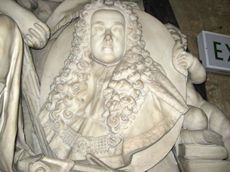
Rt Hon Lord Dudley Ryder. After a distinguished career as
Solicitor General and Attorney General, Lord Dudley Ryder was made
Lord Chief Justice of the King's Bench in 1754, a post he held
until his death in 1756.
King George II conferred on him the title of Baron of Harrowby,
but Lord Dudley died the day before the Patent was passed.
His son was to become Lord Harrowby 20 years later, after sitting
as MP for Tiverton - the first of six generations of Ryders in the
House of Commons.
|
 |
|
The second baron, who was Foreign Secretary
and Lord President, was raised to the earldom of Harrowby; and it
was his son, the second earl, who married a grand-daughter of
Thomas Coutts.
Both the fourth earl and the fifth (who
married a daughter of WH Smith, the railway bookstall pioneer)
combined distinguished parliamentary careers with partnerships in
the bank. The marble monument to Lord Dudley Ryder, which can be
found on the north wall, was sculpted by Henry Cheere in 1759.
|
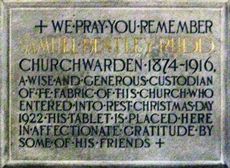 |
On the north wall is a plaque in memory of
Samuel Bentley Rudd, who was Churchwarden between 1874 and 1916, a
total of 42 years. Samuel Bentley Rudd was a notable builder whose
large premises were on Wharf Road.
He built many properties in Grantham in the
late 19th and early 20th centuries, from large houses in Welby
Gardens and his own house Welby Gate, to terraced dwellings for the
working class. He was also Borough Magistrate and was Mayor of
Grantham in 1886-1887.
|